
Let’s take a split-second and forget about Santa for a moment, his army of elves furiously making toys that will ultimately be dropped down a chimney and placed beneath every household’s tree across the globe. Let’s escape the mundane materialism of Christmas for a bit – the madness which kicks-off with Wal-Mart employees being trampled to death by crowds on Black Friday, to the last minute fights taking place aisle to aisle on Christmas Eve over the last toy every parent’s child “must have”. Let’s try for one second, to focus on something outside of ourselves. In all reality, the birth of Jesus is a landmark among Christian churches this time of year. We all can attest to the many nativity scenes outside churches throughout town. But, let’s press pause for a second, and fast-forward to the main event of all humanity. The resurrection. The resurrection of Jesus of Nazareth is arguably the most important event in human history. Don’t get me wrong, if Jesus hadn’t been born, there might not have been a resurrection at all. However, if the resurrection didn’t happen, the most influential world religion is a sham. Let’s take a deeper look.
The resurrection is simply a fantastic claim. Jesus’ own disciples didn’t believe it at first. And Jesus’ disciple Thomas struggled with it more than anyone. Nonetheless, in Thomas’s experience in particular there is hope for all of us stumbling doubters. Jesus knows how and when to reach us.
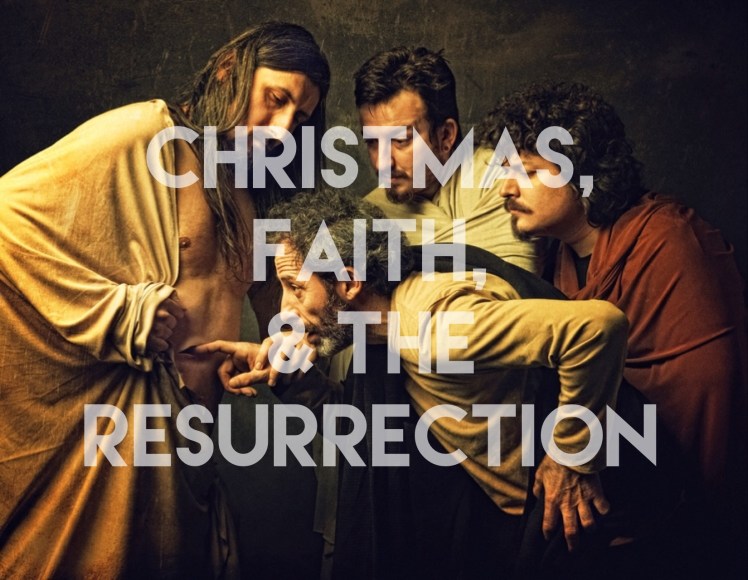
This is especially seen in Thomas’ response and his “unbelief”. Jon Bloom offers a fantastic account of what may have been going on in this scenario that some of us may recall from pictures in Sunday School, or depicted in our Kid’s Storybook Bible –
“Show me the body!” Thomas’s skeptic side shouted. At least Lazarus could be seen and touched in Bethany by any doubter. So if Jesus really was alive, why this “hide and seek” game? Wouldn’t he just show himself to them all?
He’d believe Jesus was alive when he saw him alive.
When Thomas returned to the house where the disciples had been four of them pounced on him, “We have seen the Lord (John 20:25), Thomas! It’s all true! He was just with us!”
Thomas felt a surge of shock, unbelief. Then he felt isolated. He was now the only one who hadn’t seen Jesus. In self-pity fueled anger he blurted out with more conviction than he felt, “Unless I see in his hands the mark of the nails, and place my finger into the mark of the nails, and place my hand into his side, I will never believe” (v. 25). Most of his friends were dismayed. But Peter just watched him, smiling slightly.
The following eight days were long and lonely for Thomas. His friends were gracious. No one debated him. It was, in fact, their calm confidence in Jesus’ resurrection that aggravated Thomas’ growing conviction that he was wrong. Outside he tried to maintain a facade of resolute intellectual skepticism, but inside he was wrestling and melting and wanting more than anything else to see Jesus too.
And then it happened. Thomas was staring at the floor, sinking again under the fear that maybe Jesus had rejected him because of his stubborn unbelief. If so, he knew he deserved it. Then someone gasped. He looked up and his heart leaped into his throat! Jesus was standing across the room looking at him. “Peace be with you” (v. 26).
Thomas could hardly breathe. Jesus spoke to him, “Put your finger here, and see my hands; and put out your hand, and place it in my side. Do not disbelieve, but believe” (v. 27).
All objections and resistance in Thomas evaporated. And in tears of repentance, relief, and worship Thomas dropped on his knees before Jesus and exclaimed, “My Lord and my God” (v. 28)
Within this recount, the question that comes to my mind is that there must be a difference between Thomas simply being “amazed” at the physical being of Christ standing in front of him (after he had seen him crucified a few days earlier) – and living by faith – not demanding physical proof that Jesus rose from the dead. Let’s take a minute and consider this extremely important contrast. Paul Tripp helps us out with this statement –
“There is a significant difference between amazement and faith. God doesn’t just want to blow your mind; He wants to rule your heart.”
This is an extremely important distinction one that is not made frequently enough. Faith essentially engages your brain, but it is fundamentally more than that. Faith is something that you do with your life. True biblical faith doesn’t stop with a thought; it radically rearranges the way you approach every little detail of your life. Amazement is what you experience when you are taken beyond the little categories that you carry around to explain or define things. Amazement is a step in the faith process, but there reamins a huge difference between amazement and faith.
Let’s pretend you’re standing next to me at the local state fair on a brisk fall night. We’re both fans of roller coasters and thrill rides. However, the one we are looking up at is one of those amusement park contraptions that is essentially a fifty-foot-high slingshot, into which they strap some otherwise sane human being and launch him or her back and forth into the darkness. Now, that ride amazes both of us, but we’re not about to strap in and let ourselves be launched into the night. Amazed? Yes. Jumping in line? Heck no – we will not be placing our faith in that thing. In the same way, Paul Tripp expounds upon this with a few great thoughts:
-
You can be amazed by the grand sweep of the redemptive story in Scripture and not be living by faith.
-
You can be amazed by the labyrinthine logic of the theology of the Word of God and not be living by faith.
-
You can be amazed by the great worship music you participate in every Sunday and not be living by faith.
-
You can be amazed by the love of your small group and not be living by faith.
-
You can be amazed by the wonderful biblical preaching and teaching that you hear at church on Sundays and not be living by faith.
-
You can be amazed by the grace of the cross of Jesus and not be living by faith.
There is a significant, yes, even profound difference between amazement and faith. God will not leave us in a state of amazement. He works by grace to craft us into people of settled, hopeful, courageous, active, celebratory, God-glorifying faith. He will settle for nothing less. He is not satisfied with the wonder of our minds. He works so that we really will “believe that He exists and that he rewards those who seek him” (Heb. 11.6). You can’t work that faith up in yourself. It is a gift of His grace. The resurrection makes that gift available to you right here, right now.
This brings us back to ole “doubting” Thomas and the reality of the resurrection. If we truly want to confront reality, we have to realize that we are all, in some form, a “doubting” Thomas. But let us dive deeper; How merciful is it that our Father in Heaven, in the midst of our “amazement” and lack of true faith (and an abundance of disbelief) – as we are virtually caught red-handed with our finger stuck inside the wound that the spear of the Roman soldier left in our Savior’s side – that regardless of it all, His grace would abound abundantly? His grace proves sufficient even when we so often ask to see the holes in His hands left from the nails that bound Him to the very tree upon which He bore our iniquity. So often we demand physical “proof” of Christ’s work on our behalf that we forget the very definition of faith. (Hebrews 11:1)
“The most wonderful thing in this story of Thomas is that Jesus came to him. But he did not come right away. Jesus let Thomas wrestle with his unbelief first. It exposed weaknesses in Thomas’s faith. It made him think hard about what he believed and why. I’m sure it made him more desperate and humble. But when the time was ripe, Jesus rescued Thomas from his skepticism.
And Jesus does the same for all of His doubting sheep. If you are indeed, one of His sheep, take heart.” – Jon Bloom
So this Christmas, let us be amazed at the grace displayed in the manger, but let us not lose grasp of the ramifications the manger ultimately points us toward. May the baby Jesus point us all so meaningfully to the sobering truths found only on the Cross, and only in His resurrection. The resurrection of the One we so often relentlessly doubt – yet His grace still so abundantly remains. This, my friends, is truly the gift that keeps on giving.
From the Greater Depths contributors hearts to yours,
Merry Christmas.
 GREATER DEPTHS